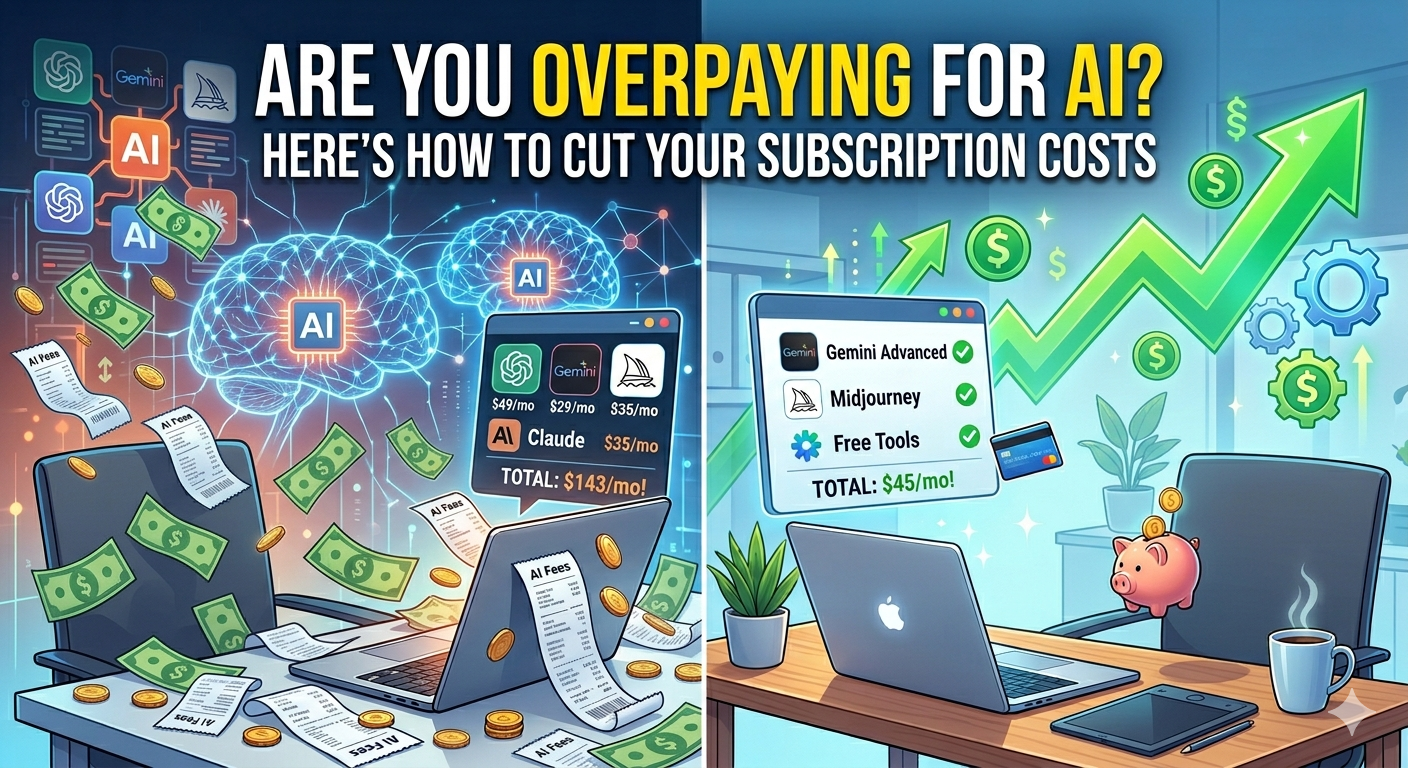
AI subscriptions have a funny way of adding up. You signed up for ChatGPT Plus because the free tier kept cutting you off. Then Gemini sounded interesting. Then someone convinced you Claude was better for writing. Then a tool you use at work started bundling Perplexity. Before you know it, you've got four or five $20/month charges on your credit card and you're using maybe one of them regularly.
You're not alone. Studies show 41% of consumers are experiencing subscription fatigue — and AI tools are one of the newest and fastest-growing contributors to that problem. The good news: there are real, practical ways to cut the cost without losing much (or anything) in capability.
What Everything Actually Costs Right Now
It helps to lay this out clearly, because the sticker price isn't always the whole story.
ChatGPT now has three tiers above free: the new Go plan at $8/month (good if you just want fewer rate limits and don't need Sora, Deep Research, or Agent Mode), Plus at $20/month, and Pro at $200/month. For most personal users, Plus or Go covers everything you'd realistically use.
Claude (from Anthropic) runs $20/month for Pro, which gets you access to the most capable models and higher usage limits. The free tier is surprisingly capable for everyday writing and research tasks.
Gemini Advanced costs $20/month — but there's a catch worth knowing about. If you're already paying for Google One storage (the 2TB plan runs $10/month), Gemini Advanced is included. That means if you're a Google ecosystem person, you may already be paying for a solid AI tool without realizing it.
Perplexity Pro is $20/month and is genuinely excellent for research and search, though many people find the free tier covers most of their needs.
Add those up at their standard rates and you're potentially looking at $60–$110/month for four tools that heavily overlap in what they can do. That's where the math stops making sense for most people.
The Free Tiers Are Better Than You Think
Here's something a lot of people don't realize: the free tiers of most major AI tools have gotten significantly better in the last year.
Free ChatGPT, free Claude, and free Gemini can all handle the majority of everyday tasks — writing, summarizing, explaining, brainstorming, basic research. The main difference at the paid tier is access to the most powerful models and higher daily usage limits.
If you're not hitting those limits regularly, you may genuinely not need to pay.
One particularly underrated free option: Google's NotebookLM. It's free, you can upload your own documents or web sources, and it creates a focused AI expert trained on exactly that material. Researchers, students, and content creators who need to work with specific sources find it invaluable and it costs nothing.
Smart Strategies for Reducing the Bill
If you've decided you do want at least one paid AI subscription, here are the moves worth considering.
Pick one and go deep. Most people who subscribe to multiple AI tools do it because they've heard different tools are better at different things and that's true, but the gap is usually smaller than the marketing suggests. Picking the one that fits your primary use case and actually learning to use it well almost always beats paying for three you skim the surface of.
Use bundle services for the rest. If you genuinely need access to multiple AIs, look at bundle subscriptions like AiZolo, which offers access to ChatGPT, Claude, Gemini, and others for around $9.90/month. That's a fraction of what individual subscriptions would cost. These work well as a secondary option when you want to try a different model for a specific task without maintaining a full-price subscription.
Check your existing subscriptions first. As mentioned above, Google One subscribers often have Gemini Advanced included without realizing it. Check what's bundled in your current services before adding anything new.
Audit what you actually use. If you've been subscribing to something for a few months and can't remember the last time you opened it, that's your answer. The 44% cancellation rate within the first 90 days of AI subscriptions reflects a familiar pattern. People upgrade in a moment of frustration, use it a lot that week, and then quietly forget about it.
When Paid Is Actually Worth It
None of this is to say that paid AI subscriptions are never worth it. For some use cases, they very clearly are.
If you're using AI daily for work that includes writing, coding, research, & content creation then the time savings alone can justify the cost within the first week. If you're hitting free tier limits consistently and it's genuinely slowing you down, upgrading makes sense. And if you need access to specific premium features (like OpenAI's Deep Research, Claude's extended context, or Gemini's integration with Google Workspace), the paid tier is often the only way to get there.
The test worth running: track your AI usage for two weeks. If you're using a paid tool at least a few times a week for things that would otherwise take you meaningfully longer, it's probably earning its keep. If it's mostly just sitting there, it's a good candidate to cut.
The Bottom Line
The AI subscription market right now is designed to get you to say "it's only $20" multiple times until the total is anything but small. A little intentionality goes a long way. Pick the tool or two that you actually rely on, make full use of free tiers where they're good enough, and keep an eye out for better pricing through bundles and bundled packages.
- AI assisted in writing this blog post