There's a scenario playing out in classrooms right now that's worth paying close attention to. A student hits a hard problem... maybe a math proof, a tricky essay argument, an unfamiliar concept in chemistry. Instead of sitting with the discomfort of not knowing, they open ChatGPT, get the answer in ten seconds, copy it down, and move on. Problem solved, but at what cost?
A growing body of research is raising a question that educators and parents need to grapple with honestly: what happens to a brain that stops having to work hard?
What the Research Actually Says
The clearest answer came from a study out of MIT's Media Lab that tracked participants writing essays with ChatGPT, with a standard search engine, or with no AI assistance at all. Researchers used EEG to measure brain engagement across 32 regions while people worked. The results were striking: ChatGPT users showed the lowest neural engagement of the three groups, and their engagement dropped further with each subsequent session. By the end of the study, many had shifted to near-complete copy-and-paste behavior. The researchers described the outcome as a buildup of "cognitive debt" a term that captures something important about what's being lost when effort is outsourced.
The Harvard Gazette covered similar concerns in late 2025, noting growing evidence that over-reliance on AI may erode cognitive habits. They found that sustained attention, working through confusion, holding competing ideas in tension is what makes deep learning possible.
A peer-reviewed paper published in PMC framed it as "the cognitive paradox of AI in education": AI can genuinely enhance learning when used thoughtfully, but unstructured use creates conditions for cognitive erosion rather than growth. And researchers at the University of Technology Sydney went further, warning explicitly that unstructured AI use in schools risks cognitive atrophy, particularly in the development of foundational knowledge and critical thinking.
None of this means AI is bad for students. But the word "unstructured" is doing a lot of work in that sentence.
Why Struggle Isn't Something to Rescue Students From
Here's the part that's easy to forget in an era of instant answers: difficulty is not a sign that something has gone wrong in the learning process. It's often a sign that something is going right.
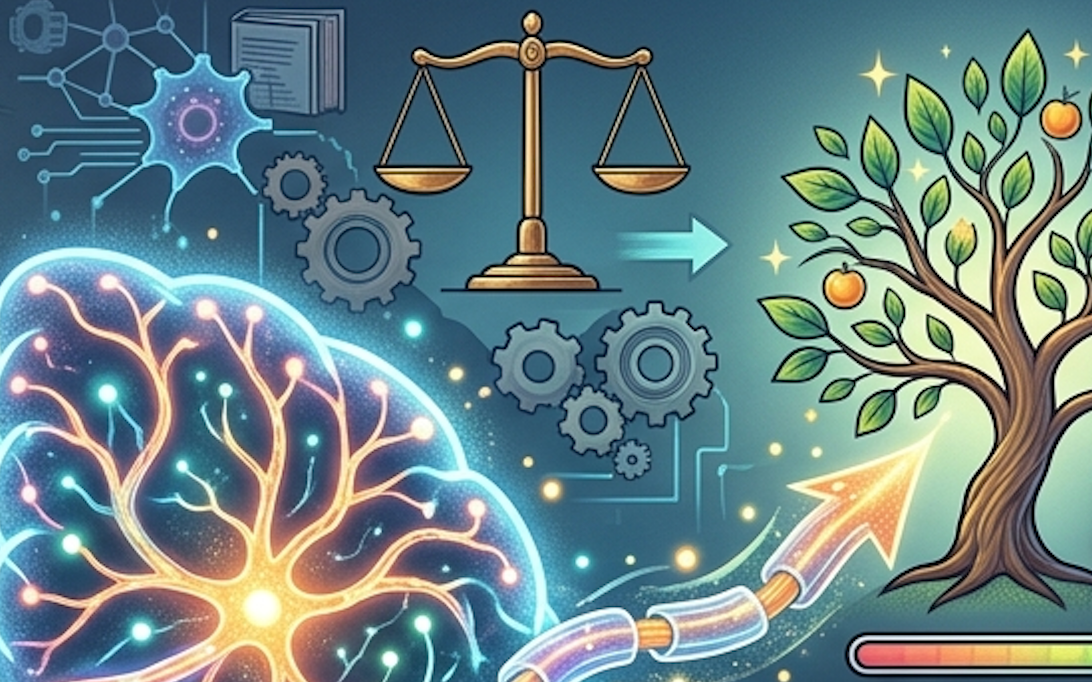
Edutopia's breakdown of the neuroscience behind productive struggle explains what's happening in the brain during effortful learning. When students work through hard problems, their brains produce myelin. That is a substance that insulates neural pathways and strengthens signal transmission. The harder the mental effort, the more myelin gets laid down, and the stronger those connections become. This is, quite literally, the physical process of getting smarter.
A meta-analysis of over 53 global studies found that students who were asked to wrestle with a problem before receiving direct instruction showed learning gains up to three times higher than those who received instruction first. The struggle, even when it ended in failure, primed the brain to absorb and retain the eventual explanation.
Research from Harvard's Graduate School of Education reinforces this: children who engage in productive struggle early develop better resilience, stronger metacognitive skills (knowing what they know and don't know), and greater capacity to handle future challenges. The struggle, in other words, isn't the price you pay for learning. It's a significant part of the mechanism.
The Real Problem: It's Not the Tool, It's the Habit
It's worth being precise about the concern here, because the nuance matters.
AI used well in an educational setting can be excellent. It can provide personalized explanations at the right level of detail, generate practice problems, offer feedback on drafts, and help students who are genuinely stuck get unstuck. A Brookings analysis of AI in education makes the case that the outcomes depend entirely on how AI is integrated. The same tool can either accelerate learning or shortcut it, depending on the context.
The problem isn't the technology. It's the habit of reaching for it before you've given your own brain a chance to engage.
When a student uses AI to avoid the discomfort of not-knowing rather than to deepen understanding after genuine effort they're trading long-term cognitive development for short-term ease. And because AI makes that trade frictionless and invisible, it's easy to do it dozens of times a day without noticing the cumulative effect.
What Teachers Can Do
This is where educators become genuinely irreplaceable in a way that AI cannot replicate.
The task isn't to ban AI. That's both impractical and would eliminate real benefits. The task is to help students develop metacognitive awareness: the ability to recognize when they should be struggling, understand why that struggle matters, and resist the reflex to outsource thinking before it's had a chance to begin.
Practically, that means designing assignments where the process is visible. Where students have to show their reasoning, not just their answers. It means asking follow-up questions: Why do you think that? What would happen if you changed this variable? Can you explain this in your own words without looking at the AI output? It means teaching students to use AI the way you'd use a knowledgeable friend. Womeone you can check in with after you've tried something, not someone you hand the problem to before you've started.
MIT Sloan's teaching guidance puts it well: the goal is to transform AI from a shortcut into a catalyst for deeper thinking, and that transformation only happens when teachers are intentional about creating conditions that require real cognitive effort first.
How I'm Using AI with My Students in CS Classes
One practical framework worth adopting: students have to earn the right to use AI. Before they're allowed to use it for coding, they need to demonstrate a level of understanding sufficient to critique, explain, and meaningfully modify whatever the AI produces. If they can't do that, they haven't earned the tool yet. There's also a reasonable carve-out for user-interface work: AI is genuinely useful for the kind of repetitive UI implementation that produces little learning and a lot of frustration. But even then, the student sketches the design first and defends every decision before AI writes a single line. The underlying principle is consistent across both cases. AI is appropriate for implementing ideas you fully own, not for solving problems you haven't genuinely wrestled with yet. That distinction, made explicit and enforced, is what separates AI as a learning accelerator from AI as a learning shortcut.
The Bigger Picture
The question isn't whether AI belongs in education. The question is whether we're being honest about what it costs when it's used as a substitute for effort rather than a supplement to it.
The research is consistent: the brain gets better at things it's asked to do, and it loses capacity for things it's never asked to do. A generation of students who've never had to sit with a hard problem, work through confusion, and arrive somewhere through their own effort will be at a real disadvantage.
The good news is that the framing is fixable. The technology isn't the enemy of learning. Unexamined, habitual reliance on it is. And that's something a good teacher, with the right conversations, can meaningfully change.
- AI assisted in writing this blog post