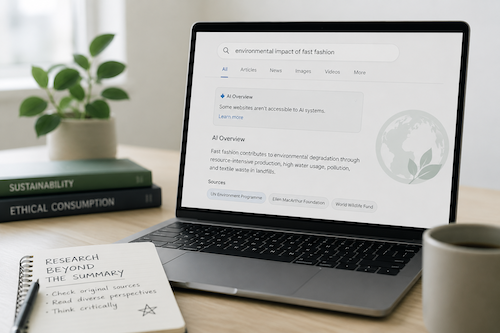
Today I want to talk about what information AI can access. Because when you ask it a question, it’s easy to assume it can pull from anything on the internet.
It can’t.
A lot of websites block AI crawlers, the bots AI companies use to gather information for training their models. But training is only part of the story. Websites can also restrict the bots AI tools use to search for information and read pages when you ask a question.
That distinction matters. What an AI learned during training and what it can look up right now are two different things.
Blocking a training crawler doesn’t erase information a company already collected. Some AI companies also pay publishers for access to their content. So a website blocking a crawler doesn’t necessarily mean its information is completely unavailable to an AI model.
But if you want AI to read a specific article today, access can be a different story.
How do websites block AI bots?
One way is through a file called robots.txt. It’s a plain text file that tells bots which parts of a website they’re allowed to crawl.
You can usually find it by adding /robots.txt to the end of a website’s domain.
The important thing to understand is that this file is a set of instructions. It doesn’t actually lock anything out. The bot has to follow the rules.
And there are different bots for different jobs. OpenAI, for example, identifies three:
-
GPTBot: Collects content that may be used to train models.
-
OAI-SearchBot: Helps websites appear in ChatGPT’s search results.
-
ChatGPT-User: Visits pages in response to user requests.
A website might allow one and block another. A publisher could want its articles to show up in search results, where readers can click through, while choosing to block collection for training.
Also, finding a page isn’t the same as reading it. An AI tool might find a title, link, or snippet without being able to access the full article.
That’s an important limitation when you’re asking it to summarize or evaluate a source.
What if a bot ignores the rules?
This is where things get a little messy.
Policies differ between companies and between types of bots. A company may treat a crawler gathering training data differently from a tool visiting a page because a person asked it to.
And since robots.txt doesn’t enforce anything on its own, websites may use stronger controls.
Services like Cloudflare can block requests before a bot reaches the website’s content. These are actual access restrictions, rather than instructions asking a bot to stay out.
AI agents make this more complicated
Then there are AI agents, the tools that can browse and interact with websites on your behalf.
Some run on the AI company’s servers. Others can control a browser on your computer, using your existing session and logins. That can make it harder for a website to tell whether you’re clicking or an agent is doing it for you.
It doesn’t make agents impossible to detect. Websites can look for patterns in requests and browsing behavior, and identification systems can help bots announce what they are.
But as agents change, detection methods have to change too. It’s a constant cat-and-mouse game.
So what does this mean for you?
When you ask AI to research something, don’t assume it has access to all the best sources. Some may be blocked, behind a login, or otherwise unavailable to that particular tool.
And a confident answer doesn’t tell you how complete the research was. The tool may explain its limitations, but you shouldn’t count on it identifying every source it couldn’t access.
Click the sources. Make sure they actually say what the AI claims. If you ask it to summarize a particular article, check that it could read the article itself.
The more the answer matters, the more you check.
And if you’re a student, that goes double. Your library’s databases may give you access to research and publications your AI tool can’t retrieve on its own.
AI can be a useful starting point. Just make sure you know what it’s working with.
Disclosure: AI was used to assist with editing and refining this article. The ideas and final content are my own.
Sources
- Steinacker-Olsztyn, Gosain, and Dao, "Is Misinformation More Open? A Study of robots.txt Gatekeeping on the Web", ACM Web Conference 2026
- NewsGuard, "AI Chatbots Are Blocked by 67% of Top News Sites"
- Graphite, "AI Now Writes as Many Online Articles as Humans"
- Ahrefs, "74% of New Webpages Include AI Content"
- Shumailov et al., "AI models collapse when trained on recursively generated data", Nature, 2024
- Jangjoo, Marsili, and Roudi, "Lost in Retraining: Closed-Loop Learning and Model Collapse in Exponential Families", Physical Review Letters, 2026
- OpenAI, Overview of OpenAI Crawlers
- Cloudflare, Web Bot Auth